
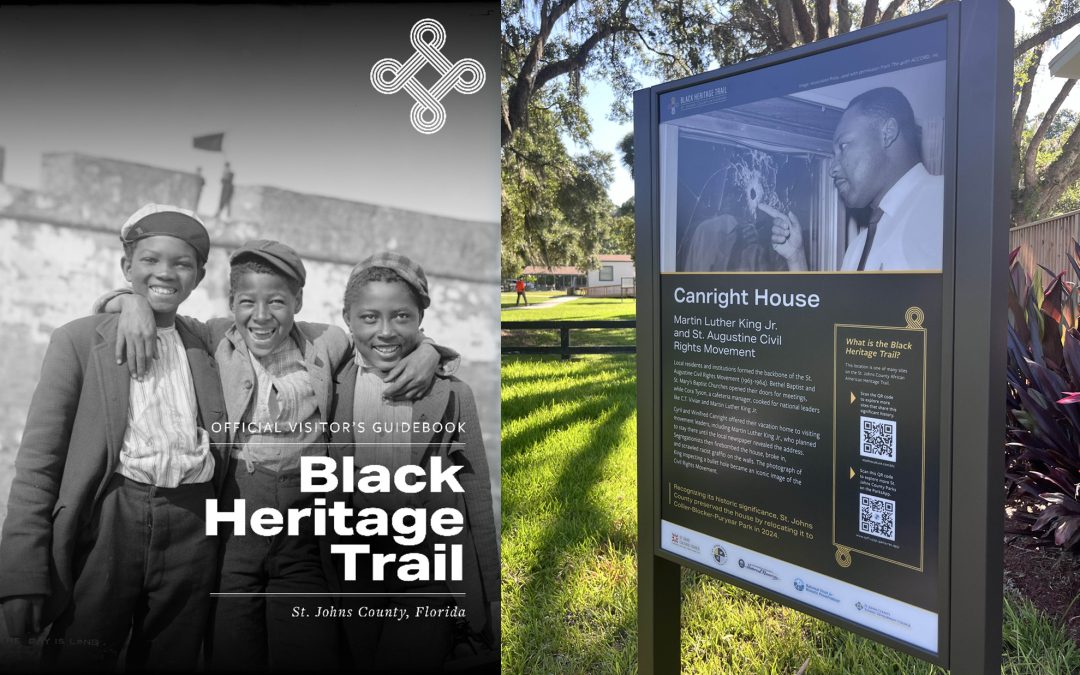
Left to right: The Black Heritage Trail Guidebook, created by the St. Johns County Cultural Council, and onsite signage in St. Johns County, exploring regional history and directing visitors to additional locations.
Creating a truly multimodal exhibition is often seen as the holy grail of design. Budgets may dictate what’s possible, but they don’t have to break the bank. (We can attest to the fact that small museums with modest resources have done this beautifully.) The trick is to think of the exhibition as a circle. Ask yourself, does one element lead naturally back to another? And don’t forget the marketing (social mentions, web banners, cookie crumbs on those rack cards!) Marketing is a critical piece that helps close the circle by connecting audiences across formats. We are proud to showcase St. Johns Black Heritage Trail in Florida as one such example, tying together web, print, and on-site experiences.
Here’s a checklist of guiding questions to help plan a multimodal approach:
- Audiences
- Who are the core audiences, and what modes of engagement will serve them best?
- Are there underserved audiences who could be reached through a different format? Make a list of random formats (Don’t limit yourself to “safe” ideas.)
- Online Access
- Is there a dedicated web portal that complements the physical experience? (This doesn’t have to be a full-fledged website, but make sure that in-depth content is available for exploration.)
- Can visitors preview stories/the exhibition online, then be guided to on-site locations, social media, or other places?
- Once digital resources are created, are they accessible (e.g., closed captioning, screen reader compatibility)?
- Print Connections (No, it’s not dead.)
- Is there a printed guidebook or brochure to accompany the exhibition or trail?
- How does print direct people to web resources, social media, or in-person experiences? This is both the pre-visit experience and a post-visit experience.
- Is print designed with accessibility in mind (font size, contrast, braille options)?
- In-Person Experience
- How do the physical elements tie into digital and print resources?
- Are there tactile components or touch-based interactives for all ages and abilities that can lead users back to digital? (Back in the day, some museums would post event photos on Flickr and encourage folks to check in to see if they made it in the album. Still a strong way of making connections!)
- Do other on-site elements point back to the web, print, or social media? (The classic selfie station is a good example of this.)
- Learning Styles & Accessibility
- Are options available for visual learners (graphics, maps, illustrations)?
- Are auditory experiences supported with transcripts or captions?
- Do tactile and sensory options allow visitors with different abilities to engage fully?
- Integration & Marketing
- How do these pieces work together to create a “cookie trail” from one mode to another?
- Is marketing—social media, PR, community outreach—used to link audiences back into the circle? Most importantly, do you think of PR/Marketing as an add-on, post-launch. This could be a missed opportunity.
- Does the visitor journey feel continuous—online to print to in-person, and back again?
These are just a few things to think about to make your content truly multi-modal, multi-platform. Have examples of where this was done exceptionally well? Ping us on LinkedIn at https://www.linkedin.com/company/quatrefoil-associates or on Instagram @Quatrefoil_Design.
This project was produced by the St. Johns Cultural Council with funding from the St. Johns County Tourist Development Council, Florida Division of Historical Resources, and the National Trust for Historic Preservation.