

In 2023, we were excited to help launch the Playhouse at the Port Discovery Children’s Museum in Baltimore. At Quatrefoil, we believe that the play isn’t just about fun and games. According to education and developmental experts, there are six key benefits of play, which can help children with physical, emotional, social, cognitive, creative, and communicative development. Over the last 30+ years, we’ve been thrilled to design a wide range of parks, playgrounds, nature trails, and museum spaces with a play-first philosophy.
The Port Discovery Playhouse is a creative play area and active theater designed for children ages 2 to 10. Working closely with the museum’s outstanding exhibit and education teams, we focused on two concepts “imagination” and “wonder,” while weaving in the key benefits of play itself.
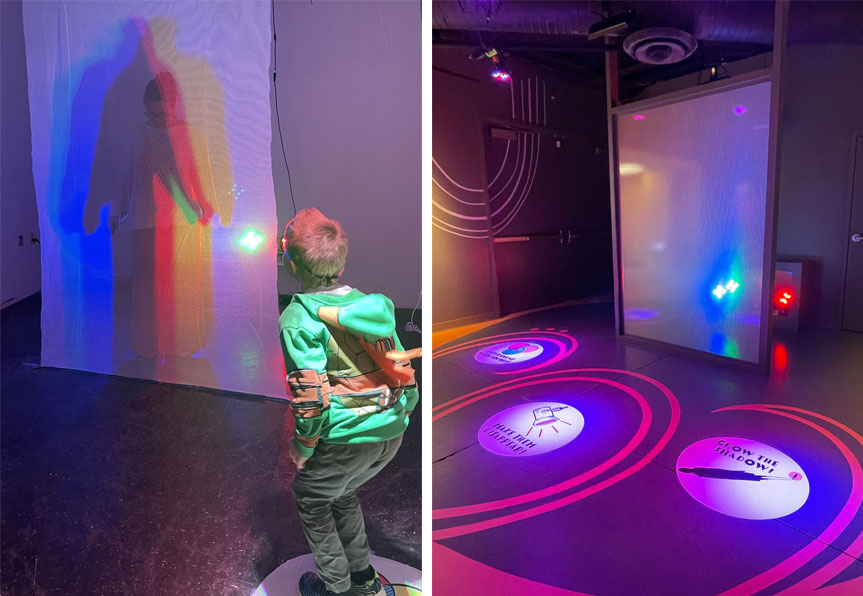
Physical Movement: Active play is essential for kids’ physical development, and it can also help children process and express their emotions. Through physical movement, children learn coordination, balance, and spatial awareness. In the Shadow Play section at Port Discovery, kids jump from icon to icon to trigger theatrical lighting effects. They can also activate their shadows, changing them into different colors and making them disappear altogether! In the Scenic Stage area, collaboratively developed with Port Discovery’s in-house team, little visitors climb through sandcastles and giant buckets on an imaginary beach. There are plenty of opportunities to crawl, dance, and jump on the stage!
Emotional and Social Development: Playing with others helps children learn the art of communication, recognizing facial expressions and body language as they interact. Beyond simple and complex social interactions, one of the best ways to stimulate brain development is through play. It allows kids to use their imaginations and create worlds of their own, where they have total control over the narrative. With our Get into Character Augmented Reality app at the museum, kids practice dealing with their emotions. As they “try on” virtual masks, they become a scary alien, a timid deer, or an aggressive wide-mouthed shark. These virtual masks (in conjunction with physical costumes), prompt kids to become actors and practice a wide range of emotions as they communicate with each other. During their interactions, they may become excited, frustrated, or empathetic, all while developing and regulating heightened emotions.

Cognition and Creative Thinking: With the Tech Booth in front of the stage area, kids can control the backdrop to create dynamic scenes—an idyllic, sunny day transforms into a stormy scene with rough seas as kids shift the scenic stages. Children can add layers of sound and light—from dark thunderstorms and heavy rain drops to the bright sunlight of a summer afternoon, complete with the sounds of soaring seagulls. Here, children learn to think, solve problems, and focus their attention. Playing in the Tech Booth, kids watch and respond to the changing scenes as little actors “perform” on the main Scenic Stage. They’ll activate sounds and lighting to enhance the story as the seagulls cry, thunder booms, and lightning envelopes the stage!

Communication Skills – In all the exhibit spaces, children learn to play together, collaborate, negotiate, and share.. On the immersive Scenic Stage, kids dramatize an imaginary world prompted by their senses, and work together to create a story. Here, the beach comes alive through an interactive wave machine as the scene changes from sunrise to a moonlit night (enhanced by lighting and sound effects – to stimulate all the senses). It’s more than just an open play area; it’s a platform for storytelling and communication. At the same time, the Get into Character Augmented Reality Activity also prompts social interactions with other children and caregivers. Using augmented reality at various kiosks, kids are delighted to become pirates, forest creatures, aliens, and more! This activity encourages children to step into different roles, while fostering creativity and delivering a dose of wonder. Most of all, this surprising activity inspires immediate communicative responses, both verbal and non-verbal.

Check out a few more projects we’ve done with children and families at the heart of our design:
- Discovery Place (Three galleries; target audience: 8–14-year-olds)
- Smithsonian Animal Connections (Smithsonian mobile truck; target audience: middle schoolers)
- Birch Aquarium (Outdoor aquarium exhibition about renewable energy; target audience: families)
- Brooklyn Children’s Museum (Traveling exhibition; target audience: 4–6-year-olds)
- National Geographic Museum (Traveling exhibition; target audience: families)
- Smithsonian National Zoological Park (Target audience: families)
- Port Discovery Children’s Museum (Theatre exhibition; target audience: 2-10-year-olds, with infant/toddler zone)
- The Textile Museum (Learning center; target audience: students, families)
- Westmoreland Museum of American Art (Family learning room; target audience: families)
- Virtual Science Center (Traveling exhibition; target audience: middle school girls)