
The Quatrefoil crew would LOVE to catch up with you at AAM this year! Stop by Booth #904 in the Museum Expo Hall to chat about upcoming projects. Drop us a line if you want to meet up at any time during the conference: info@quatrefoil.com.
We’ll also be speaking at a session with our partners at the Reginald F. Lewis Museum of Maryland African American History and Culture. Join us for:
Interpreting Lynching in Maryland:
Immersive Approaches and Ethical Choices
Friday, May 22, 2026 1:15 PM – 2:15 PM EDT
How can museums present painful histories in ways that are honest but not overwhelming, that acknowledge trauma without sensationalizing it, and that invite visitors to see themselves as agents of change? This session examines the Lynching in Maryland exhibition at the Reginald F. Lewis Museum as a case study in designing immersive, multisensory experiences that convey the gravity of racial terror while fostering dialogue and a sense of hope.
The exhibition confronts a little-known chapter in Maryland’s past through a multimodal strategy designed to present this history with sensitivity. Visitors touch engraved name plates on vessels filled with soil from lynching sites to call up details about the victims. A tactile map with braille ensures access for blind and low-vision visitors. A projection behind the vessels reveals historic headlines, silhouetted figures, and imagery that evokes anxiety without resorting to graphic detail. Spatialized “sound spots” create intimate listening experiences, while layered soundscapes combine historic recordings with poetry by a contemporary Baltimore griot. Together, these elements form a textured environment that is both visceral and personal.
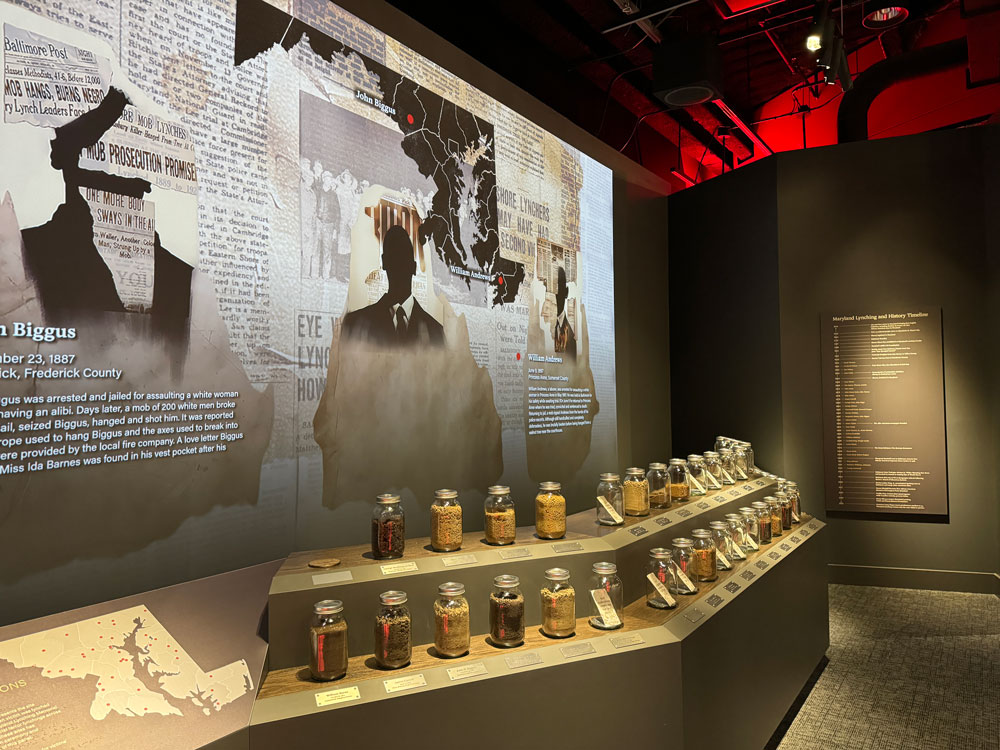
Immersive experiences at the Reginald F. Lewis Museum, Baltimore, Maryland
Equally important, the exhibition connects lynching to present-day issues such as redlining, mass incarceration, the racial wealth gap, voter suppression, and extremist recruitment online. By drawing parallels between newspapers that once incited violence and today’s social media that rewards inflammatory content, the exhibition underscores that social justice requires ongoing action. It culminates with opportunities for visitor feedback and connections to organizations working for Civil Rights.
The panel, with speakers from the museum and the design firm behind the exhibition, will address ethical questions museums face when interpreting traumatic histories. How do you avoid traumatization without whitewashing the truth? How do you decide which images, words, or headlines to show and which to omit? How do you balance the horror of injustice with opportunities for empowerment and action? Presenters will discuss the museum’s interpretive/content choices and the tangible design strategies used to achieve a balanced vision.
Attendees leave with practical ideas for selecting content, integrating multisensory storytelling, and adopting inclusive design approaches that make history accessible to all. They will hear about ways to make history relevant for contemporary audiences by employing both digital and analog methods of storytelling.